


Crypto Tax Services in 2026: What You Get and What to Ask For


CBAP (CIBA), GTP (SAIT)
Published On
Updated On
Update Due
Watch: two minutes
The Precision 7 System: every exchange, wallet, chain and DeFi position reconciled and verified, then reported.
Book a free exploratory callCrypto tax services fall into four groups: software you run yourself, software with support attached, a reconciliation firm that rebuilds your transaction history and produces the figures, and a CPA or enrolled agent who files the return. Most people need two of the four. Which two depends on how messy the history is.
The phrase covers products that do genuinely different jobs, at prices that differ by an order of magnitude, and a good deal of confusion comes from that. This guide separates them, says what each one delivers, shows where each stops working, and gives you the questions that tell a real service apart from a reseller.
The people selling those services are described as crypto tax professionals, advisors, specialists or experts, and none of those words is a credential. What separates them is whether they reconcile your data, sign your return, or represent you before the IRS: see what a crypto tax advisor is and when you need one.
What people mean by "crypto tax services"
Underneath the phrase there are two separable jobs. The first is working out what happened: every trade, transfer, swap, reward and fee across every venue and wallet you used, priced, matched and carried through to a cost basis for each unit you still hold. The second is putting the resulting figures on a return and filing it.
Software is built for the first job and assumes the data arrives clean. A CPA or enrolled agent is built for the second and assumes the figures arrive finished. Between them sits the work almost everyone with more than one venue actually needs, which is making the data clean enough for either to be true.
Is a crypto tax service the same as a crypto tax preparation service?
Not usually. "Preparation" in US tax language means preparing the return itself, and anyone doing that for compensation needs a preparer tax identification number from the IRS. Most crypto tax preparation services prepare a gain and income calculation, not a Form 1040. Read the deliverable, not the label: ask whether the output is a report you hand to a preparer, or a signed return.
Where does "crypto tax help" fit?
"Help" is usually one of three situations: you cannot get your data out of a venue, you cannot make the numbers balance, or a letter has arrived. The first two are reconciliation problems. The third may need a CPA, an enrolled agent or an attorney, because those are the practitioners the IRS lets represent you. Our guide to crypto tax help sets out the free IRS programs and when paid help is worth it.
The four tiers, compared
The tiers stack. Each one assumes the tier below it has been done properly, by you or by someone else.
| Tier | What you get | Where it stops |
|---|---|---|
| Self-serve software | API and CSV imports, price lookups, a gain calculation | Anything it cannot classify, which it reports as a guess or a gap |
| Software plus support | The same engine, with a person answering questions about it | Support explains the tool, it does not rebuild your history |
| Reconciliation firm | A rebuilt, balanced transaction history and finished figures | It is not the filing, and normally not representation |
| CPA or enrolled agent | The return prepared, signed and filed, representation if needed | Charges by the hour to fix data, if they take the work at all |
The cost profile of each tier differs sharply, and the comparison is easier once you have seen the ranges in one place. Our guide to what a US crypto CPA costs sets them out, and Koinly versus hiring a crypto accountant covers the specific decision between tier one and tier three.
What a reconciliation service actually delivers
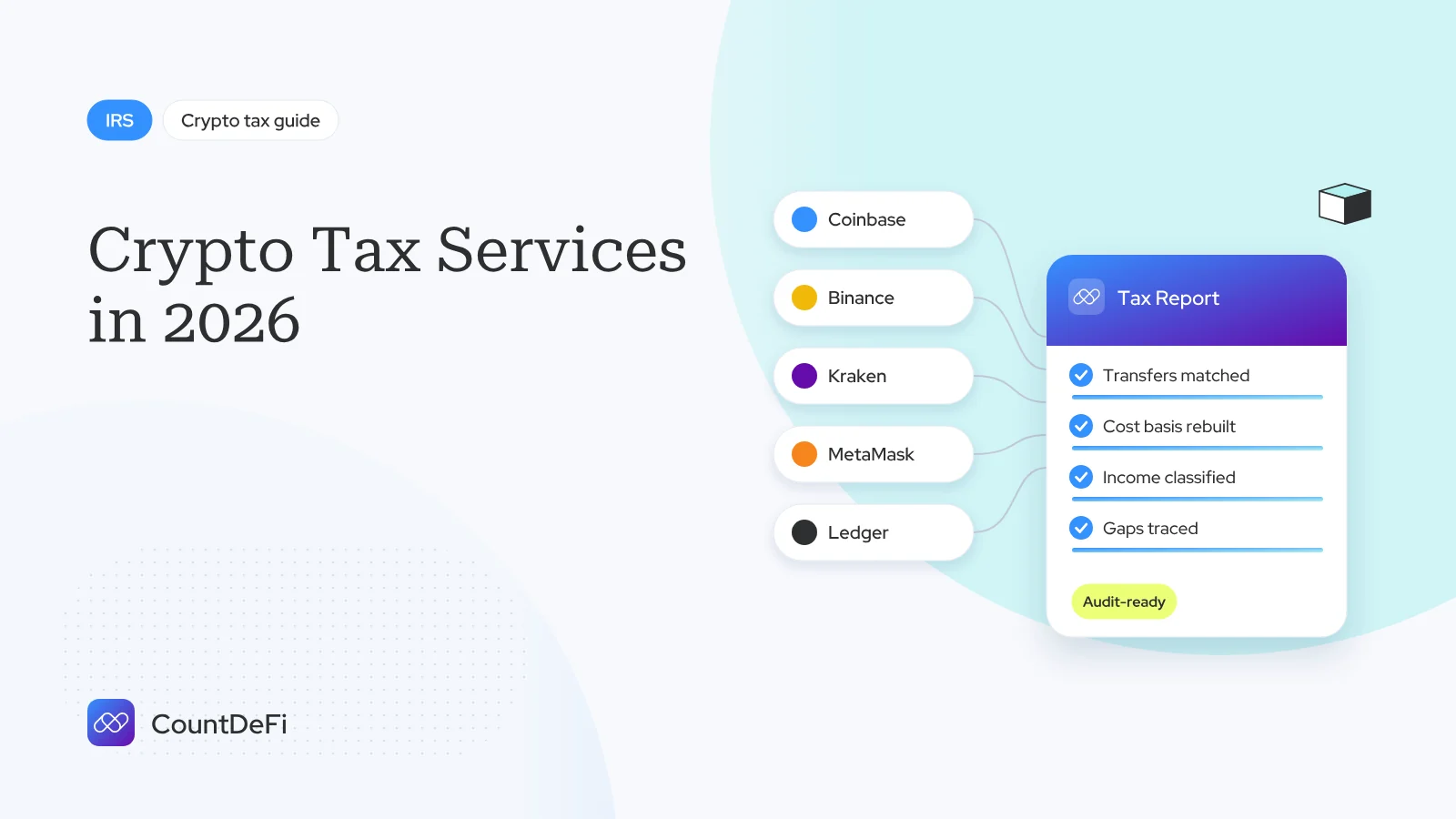
This is the tier people understand least, because its output is invisible until something is wrong. A reconciliation service takes every source you have, exchange exports, API pulls, on-chain addresses, and rebuilds a single ledger from the first transaction you ever made, not from the start of the tax year. It then proves that ledger against reality: the balance the engine says you hold at year end has to equal the balance the venue or the chain says you hold.
What is in the report pack?
For a US engagement the pack is a capital gains report, an income report, and the figures in the form your preparer needs for Form 8949 and Schedule D, with the disposal detail behind them. Digital assets are property under IRS Notice 2014-21, so every disposal is a capital gain or loss event and the pack has to show the acquisition behind each one.
How is a missing cost basis handled?
By tracing it, not by defaulting it. A unit bought on a venue that has since closed still has a real acquisition price, and the trail to it is usually a bank record, an old statement or the transfer that carried it out. Where basis genuinely cannot be established, the treatment has to be stated rather than hidden. We cover the full sequence in how to fix missing cost basis.
Why does the tracking method matter?
Because it changes the numbers. Revenue Procedure 2024-28 set out a safe harbour for allocating unused basis to each wallet or account, which moved the default from a single universal pool toward per-account tracking. A service that cannot tell you which method your figures were produced under cannot tell you whether they are right.
Where each tier stops working
Every tier has a boundary, and the failures are predictable.
Which histories break tax software?
Software reads transactions, not intent. It handles exchange trades and plain transfers well. It struggles the moment the meaning of a transaction depends on the protocol: liquidity positions, perpetuals, restaking, bridges, wrapped assets, lending receipts. Those arrive as token movements with no label, and a wrong label becomes a wrong disposal. The DeFi reconciliation guide works through the specific cases.
What makes a history expensive to reconcile?
Not transaction count on its own. The expensive properties are the number of distinct venues and chains, the number of years since inception, whether any venue has closed, whether the same asset was moved between platforms repeatedly, and whether protocol activity is involved. A hundred thousand exchange trades on one venue is cheaper work than four thousand transactions spread over nine wallets and a dead exchange.
What if the exchange no longer exists?
The data still exists somewhere: old downloads, email confirmations, bank rails on the fiat side, and the chain itself for anything you withdrew. The reconstruction is real work but it is not guesswork, and it is set out in our guide to recovering records from a dead exchange.
Preparation is not filing: who signs the return
This distinction decides which services you need, and it is the one most often blurred in marketing copy.
Who may represent you before the IRS?
The IRS is explicit: "Enrolled agents, certified public accountants, and attorneys have unlimited representation rights before the IRS", and may represent clients on audits, collection and appeals, while any professional holding a PTIN is authorised to prepare federal returns. The full breakdown is on the IRS page on tax return preparer credentials and qualifications. If representation is what you need, that is the credential to look for.
Can a reconciliation firm file for you?
Not unless it also holds that credential, and most do not. CountDeFi does not. The normal shape of the engagement is that the reconciliation produces the figures and your CPA or enrolled agent puts them on the return. The two roles are compared directly in crypto CPA versus crypto tax accountant.
Why does the split save money?
Because reconciliation billed at filing rates is the most expensive way to buy it. A preparer who receives a finished, balanced pack spends their time on the return. A preparer who receives a folder of CSV exports spends it on data, at their hourly rate, and often declines the work instead.
Where the reconciliation service and the filing preparer are two different firms, agree at the start who answers a question about a specific transaction and who answers a question about its treatment. Who prepares crypto tax reports for your CPA walks through that handover and what the package has to contain.
Scope your own job before you ask for a quote
Quotes vary because scopes vary, and a quote given without these facts will move later.
The six facts every quote depends on
- Which tax years are open, and whether any prior year was filed on figures you now doubt.
- Every venue you have used since your first purchase, including ones you closed.
- Every wallet address, including hardware wallets you only ever received into.
- Whether you touched DeFi, staking, restaking, perpetuals, NFTs or prediction markets.
- Whether any venue has shut down, restricted exports or lost your history.
- Whether a letter or notice has already arrived.
Staking is worth naming explicitly, because Revenue Ruling 2023-14 puts rewards into gross income when you gain dominion and control over them, which means a reward stream is an income schedule as well as a set of new acquisitions.
What to ask when you compare providers
Price per transaction is the least useful comparison available, because it says nothing about what is included.
Questions that separate a real service from a reseller
- Do you reconcile from inception, or only the engaged year?
- Do you verify closing balances against the venue and the chain, and will you show me that?
- What happens when a cost basis cannot be traced?
- Which tracking method are my figures produced under?
- Is the fee fixed for the scope, or hourly?
- Who files the return, and do you hold a credential to do it?
- What exactly do I receive at the end?
The balance question is the sharpest of the seven. A gain figure produced from a book that does not tie to the assets you actually hold is arithmetic on the wrong data, and a proceeds figure arriving at the IRS on Form 1099-DA with no basis behind it is exactly the mismatch that generates a notice. We cover that failure mode in the Form 1099-DA guide.
What CountDeFi does and does not do
We are crypto tax accountants. We reconcile transaction histories across exchanges, wallets and protocols, verify closing balances against the venues and the chains, and produce a documented report pack with the gain and income figures your preparer needs. Work is done on fixed fees against an agreed scope, and the detail sits on our crypto tax accounting service page.
We are not a CPA firm, we employ no CPA, and we do not file US returns or represent clients before the IRS. Where you need that, your own CPA or enrolled agent files from our pack, and we answer their questions about it directly.
- IRS Notice 2014-21: virtual currency is treated as property
- IRS Revenue Procedure 2024-28: safe harbour for allocating unused basis
- IRS Revenue Ruling 2023-14: staking rewards and dominion and control
- IRS: tax return preparer credentials and qualifications
- IRS: About Form 8949
- IRS: About Schedule D (Form 1040)
- IRS: About Form 1099-DA
- IRS: Digital assets
Frequently Asked Questions
What is included in a crypto tax service?
It depends on the tier. Software gives you imports and a calculation. A reconciliation firm gives you a rebuilt transaction history, verified closing balances and finished gain and income figures. A CPA or enrolled agent gives you the prepared return. Ask for the deliverable in writing before you compare prices.
Do I need one if I only used a single exchange?
Probably not. One venue, no withdrawals to a private wallet and no protocol activity is the case tax software handles well, and the exchange's own export is usually enough to work from. The value of a service rises with the number of venues, wallets and years involved.
Is crypto tax preparation the same as filing?
No. Preparation covers producing the figures and, where the provider is credentialed, the return itself. Filing is submitting it. Many services described as preparation stop at the figures, so confirm which one you are buying.
Can a service fix prior years?
Yes, and prior years are often where the real problem sits, because cost basis carries forward. A current year cannot be correct if the acquisitions behind it were never reconciled. Whether a filed year should then be amended is a decision for you and your preparer.
What if my exchange closed and I have no records?
The history is normally recoverable from other sources: bank records on the fiat side, email confirmations, counterparty statements and the chain itself for anything withdrawn. It takes time rather than luck, and it is a standard part of a reconstruction engagement.
Do I still need a CPA?
If you are not filing yourself, yes. Reconciliation and filing are separate services, and only enrolled agents, CPAs and attorneys hold unlimited representation rights before the IRS. Buying them separately is usually cheaper than asking a filer to also clean the data.
How much do crypto tax services cost?
Ranges differ by tier and by how much reconstruction the history needs. We publish the comparison in our guide to crypto CPA costs, and quote fixed fees against a defined scope rather than an hourly rate.
Is a crypto tax professional the same as a crypto tax service?
No. A crypto tax service is the product you buy, from self-serve software to a full reconciliation engagement. A crypto tax professional is the person delivering it, and only an enrolled agent, CPA or attorney can also file and represent you before the IRS.
What is a crypto tax reconciliation service?
A crypto tax reconciliation service rebuilds your full transaction history from exchange exports, wallet addresses and on-chain data, matches transfers between your own accounts, prices every disposal and proves the closing balances tie to what you actually hold. It produces the figures a return needs. It does not file the return.
Chris Herbst is the founder of CountDeFi, a crypto tax specialist whose qualifications span investment management, financial analysis, mathematical statistics and computer science. He holds the Chartered Business Accountant in Practice (CBAP) designation with the Chartered Institute for Business Accountants (CIBA) and the General Tax Practitioner (GTP) designation with the South African Institute of Taxation (SAIT). His combined background in investments, accounting and tax, mathematical statistics and computer science underpins his work in complex crypto tax reporting. This article is for educational purposes only and does not constitute tax, legal or investment advice. Consult a qualified tax professional for guidance specific to your situation. View our Editorial Policy.

