


Who Prepares Crypto Tax Reports for Your CPA?


CBAP (CIBA), GTP (SAIT)
Published On
Updated On
Update Due
Watch: two minutes
The Precision 7 System: every exchange, wallet, chain and DeFi position reconciled and verified, then reported.
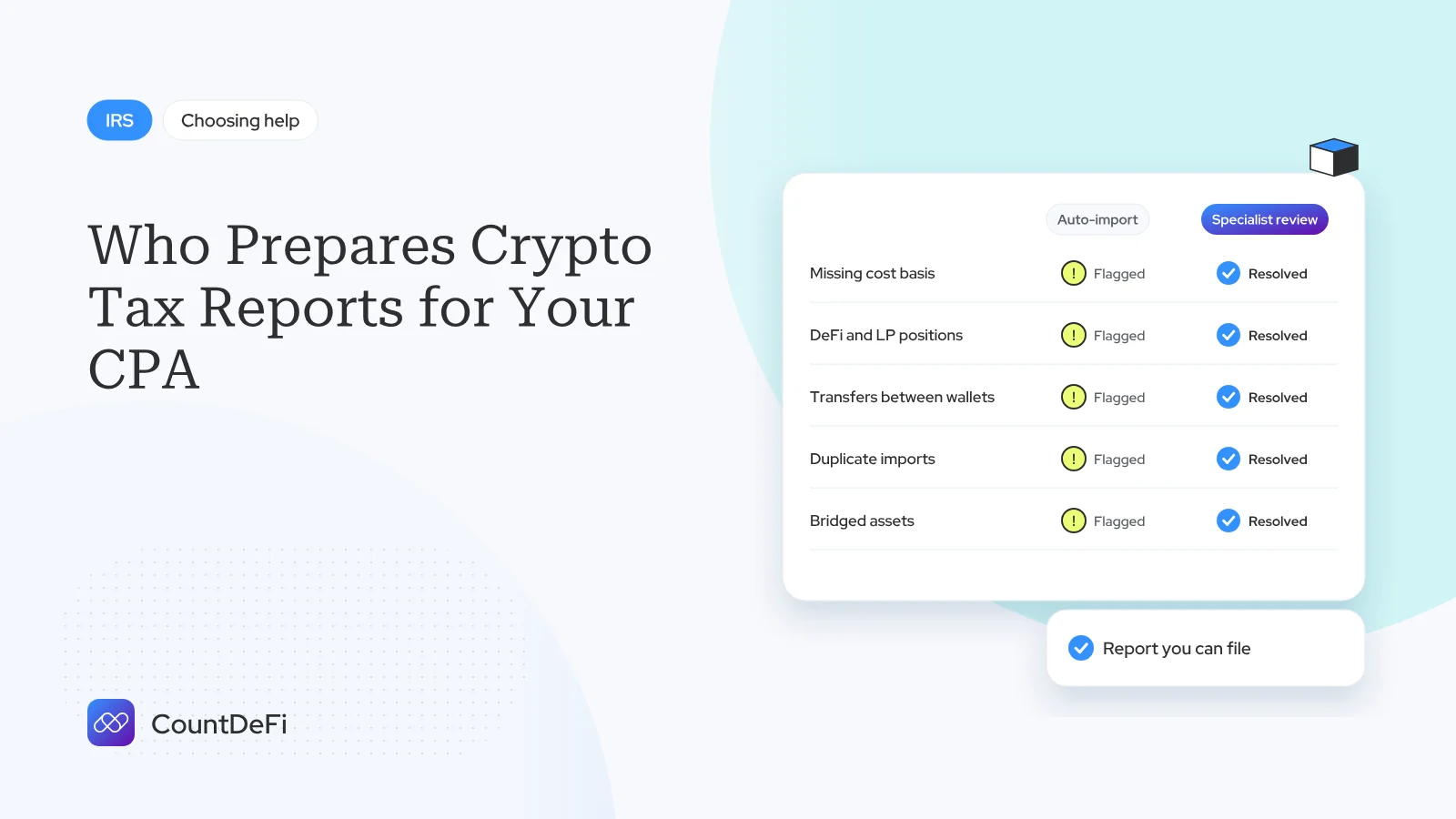
Book a free exploratory callShort answer: a crypto tax accountant or reconciliation firm prepares the reports. They rebuild your transaction history across every exchange, wallet and chain, establish cost basis, classify each event, and hand your CPA a package your CPA files from.
The package is the capital gains report, the income report, the Form 8949 figures and a reconciled ledger that ties to what your wallets actually hold. CountDeFi does the reconciliation and reporting; it does not file returns.
This guide explains who does that work, what the finished package contains, why CPAs ask for it, and how to check that the numbers will hold up.
Who prepares crypto tax reports for a CPA?
Three kinds of provider produce the figures a CPA files from. They are not interchangeable.
Crypto tax software you run yourself
You connect exchange APIs, import wallet addresses and CSV exports, and accept whatever the tool produces. For a small, clean history on one or two exchanges this works. For a fragmented history it produces a number with no evidence that the number is right, and the errors compound quietly: unmatched transfers become phantom sales, deposits with no source become zero-basis acquisitions.
A CPA who does the reconciliation in-house
Some CPA firms have built a crypto practice and do the data work themselves. The IRS's guide to preparer credentials explains what the CPA licence covers; whether a given firm can trace basis through a bridge is a question about that firm, not about the licence. Ask how they handle transfers between your own wallets before you assume they do.
A specialist reconciliation firm
A crypto tax accountant works the data full time and hands the finished package to your preparer. The split is the same one that already exists between a bookkeeper and a tax preparer for a business: one builds the records, the other signs the return. CountDeFi sits in this category. We explain the two roles in crypto CPA versus crypto tax accountant.
What is in the report package your CPA files from
A usable package is not a spreadsheet of trades. For a US filing it should contain the following.
| Document | What it contains | Where it goes |
|---|---|---|
| Capital gains report | Every disposal with acquisition date, cost basis, proceeds, gain or loss and holding period | Form 8949 and Schedule D |
| Form 8949 figures | Short-term and long-term lots, grouped by whether a broker reported basis | Form 8949, Parts I and II |
| Income report | Staking, mining, airdrops, referral and interest receipts at fair market value when received | Schedule 1 or Schedule C, depending on the facts |
| Reconciled transaction history | Every event, classified, with transfers between your own accounts matched | Working papers behind the return |
| Closing balance reconciliation | The book's closing holdings per wallet against what the wallets and exchanges actually held | Working papers; the check that the history is complete |
| Source inventory | Every exchange, wallet and chain included, and anything that could not be | Working papers; what the CPA and an examiner will ask for first |
The last two rows are the ones people skip and later regret. If the closing balance in the report does not match what the wallet holds, the history is incomplete and every figure above it is provisional.
Why CPAs ask for reconciled data
The signature carries exposure
A CPA signs the return as paid preparer, and practice before the IRS is governed by Circular 230. A preparer who signs wants numbers they can stand behind and a trail they can produce if the return is examined. Raw exchange exports do not give them that.
Raw exports do not describe events
A withdrawal from one exchange and a deposit into a wallet are two rows in two files. Nothing in either file says they are the same coins. Tax software guesses; a reconciliation firm matches them and proves it. Because the IRS treats digital assets as property under Notice 2014-21, an unmatched transfer is booked as a disposal and taxed as one.
Broker forms do not close the gap
Form 1099-DA gives the IRS a view of proceeds from brokers. The instructions set out when basis is reported, and for assets you transferred onto the exchange from a wallet the broker often has no basis to report. The CPA then has a proceeds figure from the broker and no basis to set against it. The reconciled history is what supplies the basis. Our Form 1099-DA guide covers the mismatch in detail.
Thousands of transactions across many wallets
This is the situation most people are in when they start looking for help: several exchanges, a hardware wallet, a few hot wallets, activity on two or three chains, some staking, a period of DeFi, and years of it. Volume on its own is not the hard part. Software handles volume. The hard parts are these.
Transfers between your own accounts
Every one has to be matched send to deposit, with the network fee accounted for. A missed match is a taxable event that never happened.
Basis through bridges, wraps and pools
When a token is wrapped, bridged or deposited into a liquidity position, the basis has to follow it and come back out on the other side. Under Revenue Procedure 2024-28 basis is tracked wallet by wallet, so the tracing has to be done per wallet rather than in one pool. Our guide to universal versus wallet-based cost tracking explains what changed.
Income events that look like transfers
Staking rewards, airdrops and forks arrive as inbound transfers with no counterparty. Revenue Ruling 2023-14 and Revenue Ruling 2019-24 set out when they are income; the ledger does not label them, so someone has to.
Missing history
A closed exchange, a lost seed phrase, an API that only exports the last twelve months. The provider has to find the gap, name it, and either close it from another source or record what remains unverified. Our cost basis guide shows what a missing acquisition does to the return.
What a crypto tax reconciliation service actually does
A crypto tax reconciliation service rebuilds your full transaction history across exchanges and wallets, matches transfers between your own accounts, traces cost basis to each sale, and checks the result against the balances each account reports. The output is a report your CPA files from. Our US crypto tax accountants do this work.
The work runs in a fixed order, and each step depends on the one before it.
1. Collect every source
Exchange histories by API and export, every wallet address on every chain, statements from platforms that have closed, and your own notes on what a given transfer was for.
2. Normalise and match
Different exports describe the same event in different formats. They are brought into one ledger and transfers between your own accounts are matched on hash, amount and timing.
3. Classify
Every remaining event is classified: purchase, sale, swap, income, gift, loss, transfer, bridge, wrap, pool entry or exit. The classification decides the tax.
4. Establish basis
Basis is traced from the first acquisition through every hop to each disposal, per wallet, under the lot identification method the return will use.
5. Verify balances
The book's closing holdings are compared to what each wallet and exchange actually holds. A mismatch is a defect in the history and is chased before any figure is reported.
6. Report
The capital gains report, the income report, the Form 8949 figures and the reconciled history are produced from the one verified ledger, so they agree with each other by construction.
7. Hand off
The package goes to your CPA, enrolled agent or tax attorney, with the source inventory and the balance check attached. If they have questions, the answer traces to specific transactions.
Reconciliation service versus crypto tax software
Software is a tool inside the process, not a substitute for it. CountDeFi runs client books in Koinly and is its number one global partner; the difference is what happens to the exceptions. Software will always produce a number. It has no way of telling you that the number is wrong because a transfer went unmatched or a source was never connected. A reconciliation service works those exceptions one at a time and checks the result against the wallets. For a clean history the two arrive at the same answer; for a fragmented one they do not.
What to give your provider
The engagement moves faster when you arrive with a list of every exchange account you have ever opened, including closed ones; every public wallet address, including hardware wallets and wallets you no longer use; the chains you have been active on; any prior-year returns and the reports they were filed from; and your own notes on transfers whose purpose only you know, such as payments to another person or a loan repaid in kind. The last point is the one only you can supply. Chain data shows a transfer left your wallet. It cannot show that it was a gift to your brother.
How to check the reports will hold up
Before you pass anything to your CPA, ask the provider three questions.
Do the closing balances match the wallets?
If the report says you hold 4 BTC and the exchange says 0.3, the history is missing something, and every gain computed above it is provisional.
Which sources were not included, and why?
Silence here is the answer you do not want. A named gap you can act on; an unnamed one sits in your return.
Can you show me where this number came from?
Every figure should trace to specific transactions. If the answer is "the software says so", nobody has checked it. If the IRS asks later, that is the question they will ask; see our guide to IRS crypto audits.
If you want the reconciliation handled and the package handed to your own accountant, that is exactly what the CountDeFi crypto tax accounting service does. CountDeFi is not a CPA firm and does not file returns or represent clients before the IRS. Founder Chris Herbst holds the Chartered Business Accountant in Practice (CBAP) designation with the Chartered Institute for Business Accountants and the General Tax Practitioner (GTP) designation with the South African Institute of Taxation. Book a call and bring your list of exchanges and wallets.
Official Sources
- IRS: About Form 8949: the form each digital asset disposal is reported on.
- IRS: About Schedule D: where the Form 8949 totals land.
- IRS Instructions for Form 1099-DA: what brokers report and when basis is included.
- IRS Notice 2014-21: digital assets treated as property.
- IRS Revenue Procedure 2024-28: wallet-by-wallet basis identification.
- IRS Revenue Ruling 2023-14: staking rewards as income.
Frequently Asked Questions
Who can prepare crypto tax reports for my CPA?
A crypto tax accountant or a specialist reconciliation firm. They rebuild your transaction history across every exchange, wallet and chain, establish cost basis, and produce the capital gains report, the income report, the Form 8949 figures and a reconciled ledger. Your CPA files from that package.
Does my CPA have to accept reports from another firm?
CPAs file from third-party records all the time: brokerage statements, payroll reports, bookkeeping ledgers. A reconciled crypto package is the same kind of input, with the evidence trail attached. Most CPAs prefer it to raw exchange exports.
What if my CPA already uses crypto tax software?
Then the question is who works the exceptions the software raises: unmatched transfers, missing basis, unclassified DeFi events. If nobody does, the return carries the software's guesses. A reconciliation firm can start from the same software account and resolve them.
Can a reconciliation firm file my return?
Only if it also holds a CPA licence, an enrolled agent credential or is a law firm, with a PTIN. CountDeFi does not file returns. It prepares the package and hands it to the preparer you choose.
How long does reconciliation take for thousands of transactions?
It depends on how many sources there are and how many gaps, not on the transaction count alone. A complete set of exports and wallet addresses at the start is the single biggest factor.
What does the package cost?
Reconciliation is priced on transaction volume and complexity rather than portfolio value. We set out the ranges in what a crypto CPA costs.
Does the package cover prior years?
Yes, and it usually has to. Basis for this year's disposals comes from acquisitions in earlier years, so the history is rebuilt from the first transaction, even when only the current year is being filed.
Master the topic: Best Crypto Tax Accountants and CPAs for US Investors in 2026
Chris Herbst is the founder of CountDeFi, a crypto tax specialist whose qualifications span investment management, financial analysis, mathematical statistics and computer science. He holds the Chartered Business Accountant in Practice (CBAP) designation with the Chartered Institute for Business Accountants (CIBA) and the General Tax Practitioner (GTP) designation with the South African Institute of Taxation (SAIT). His combined background in investments, accounting and tax, mathematical statistics and computer science underpins his work in complex crypto tax reporting. This article is for educational purposes only and does not constitute tax, legal or investment advice. Consult a qualified tax professional for guidance specific to your situation. View our Editorial Policy.

