


Crypto Tax Evasion and Operation Hidden Treasure



CBAP (CIBA), GTP (SAIT)
Published On
Updated On
Update Due
Watch: two minutes
The Precision 7 System: every exchange, wallet, chain and DeFi position reconciled and verified, then reported.
Book a free exploratory callWhat is Operation Hidden Treasure?
Operation Hidden Treasure was introduced on March 5, 2021, by the IRS Director of the Office of Fraud.
You may feel like the IRS is not always on your side, but you cannot argue their creative abilities in naming departments needs a gold star. Operation Hidden Treasure is unfortunately not the next title of the Pirates of the Caribbean film series.
Operation Hidden Treasure was explicitly designed to bring taxpayers to justice for trying to “hide” their crypto income. But, unfortunately, they are starting to make examples of some taxpayers to push fear into the space and let you know that big brother is, in fact, watching.
In our recently released blog “United States: 6 Crypto Myths busted!” we explored different myths in the crypto community. One of the biggest myths is that taxpayers say, “Nobody can trace any of my blockchain transactions” in fact, this is not the case; your transaction is traceable.
Anonymity is a big attraction in the Decentralized Finance (DeFi) world, but you need to remember that blockchain is a public ledger. Every transaction is verified, and this makes all the transactions public domain.
The government is able to track and link these “anonymous” wallets to people, exactly because of this transparency. The main reason is that nearly all people’s transactional history is an on-ramp (starting point) via a KYC (know-your-customer). Exchanges are required to follow these KYC rules that regulatory authorities have implemented. In addition, most exchanges have already been requested to report their customer’s crypto activities to IRS.
This makes it possible for the IRS to partner with private firms like Chainalysis, which connects real-world activities to blockchain transactions and enables them to track your transactions.
What is the IRS looking for?
It is all in the name, hidden treasure. If you have found your pot of gold on the other side of the crypto rainbow and perhaps kept that secret all too safe, it is possible they are looking for a few extra coins from you.
The IRS is most likely looking for people with tremendous gains in the market - that made a lot of profit. Profits, or gains can come from a sale, swap, exchange, staking coin, airdrops or utilizing that token or coin in another way. And it is important to report it on your taxes.
3 Examples of crypto transactions considered to be tax evasion
- People who structure their transactions to mask the transaction activity: meaning structuring your transactions in $10 000 or less, as it is stated in the money laundering law or if you are trying to take your money out of the bank, amounts of $10 000 & higher needs to be reported to the IRS.
- Holding companies or shell companies to hide your coin assets from the IRS, forensic accounting would be able to identify this behaviour and if you mask your transaction history through a shell company this is seen as tax aviation.
- On and off-blockchain transactions, for example, cash to bitcoin or bitcoin to cash – without reporting the transaction.
Doing the above or perhaps being more creative could be considered tax evasion. Although the IRS does not pursue criminal tax evasion cases for many people, the penalty for those caught is harsh. They must repay the taxes with an expensive fraud penalty and possibly face jail time of up to five years.
Income Tax Form 1040
Do remember to tick the box on your individual income tax form 1040; if you did receive, sell, exchange or otherwise dispose of any financial interest in any virtual currency.
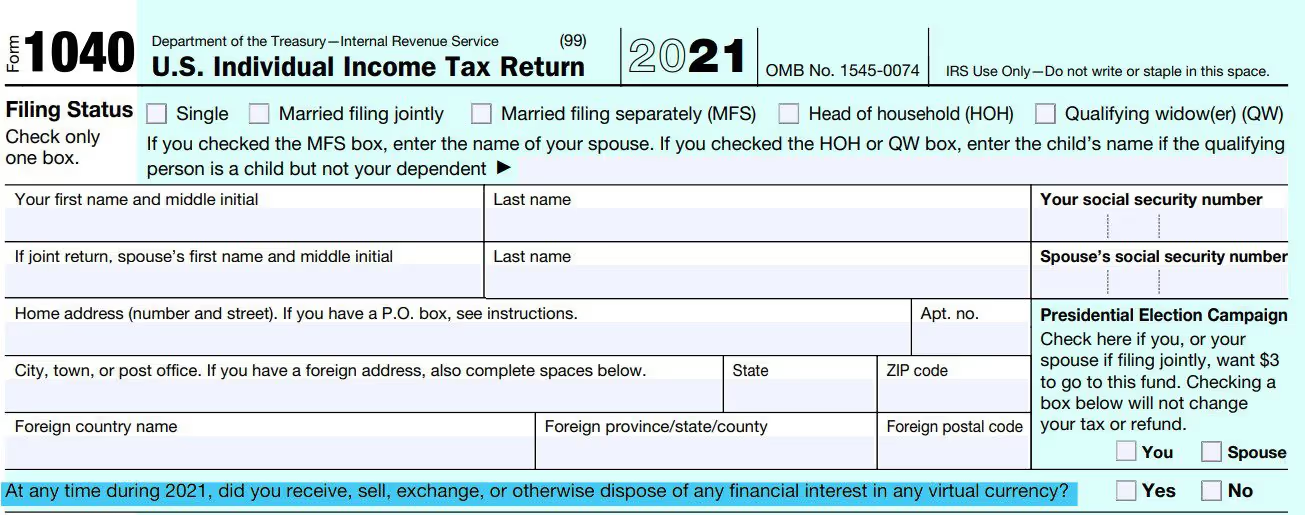
If you are not so familiar with how your virtual currency is taxed or seen in the IRS’s eyes, do yourself a favor and contact a professional with the necessary knowledge to keep you in compliance because ignorance is never a good fallback.
Official Sources
- IRS: Digital Assets: the central IRS page on how digital assets are taxed and reported.
- IRS: Form 1040 Digital Assets question: the IRS reminder on answering the digital asset question and reporting all crypto income.
- IRS: About Form 8300: the reporting rules that sit behind the $10,000 threshold.
- IRS: Criminal Investigation Voluntary Disclosure Practice: the route for taxpayers who want to come forward before the IRS reaches them.
Frequently Asked Questions
What is Operation Hidden Treasure?
It is an IRS initiative introduced on 5 March 2021 by the IRS Director of the Office of Fraud, aimed at taxpayers who hide crypto income. Part of its purpose is visible enforcement, making examples of some taxpayers so the wider market understands that the activity is being watched.
Can the IRS really trace blockchain transactions?
Yes. The blockchain is a public ledger and every transaction is verified and publicly visible. Most people enter the market through an exchange that applies know-your-customer checks, which is what allows an address to be linked back to a person, and the IRS partners with private firms such as Chainalysis to make that connection.
What kinds of crypto activity are treated as tax evasion?
Structuring transactions to stay under the $10,000 reporting level and mask activity, using holding or shell companies to hide coin assets, and moving between cash and crypto on and off the blockchain without reporting it. Forensic accounting can identify these patterns.
What are the penalties for crypto tax evasion?
The IRS does not pursue criminal tax evasion cases against most people, but the penalty for those caught is harsh. It means repaying the tax with an expensive fraud penalty and possibly a jail term of up to five years.
What is the IRS looking for?
Large unreported gains. Profit can come from a sale, a swap, an exchange, staking, an airdrop or any other use of a token or coin, and each of those needs to be reported. The digital asset question on Form 1040 also has to be answered if you received, sold, exchanged or otherwise disposed of any financial interest in virtual currency.
Master the topic: Can the IRS Track My Crypto in 2026? Yes.
Chris Herbst is the founder of CountDeFi, a crypto tax specialist whose qualifications span investment management, financial analysis, mathematical statistics and computer science. He holds the Chartered Business Accountant in Practice (CBAP) designation with the Chartered Institute for Business Accountants (CIBA) and the General Tax Practitioner (GTP) designation with the South African Institute of Taxation (SAIT). His combined background in investments, accounting and tax, mathematical statistics and computer science underpins his work in complex crypto tax reporting. This article is for educational purposes only and does not constitute tax, legal or investment advice. Consult a qualified tax professional for guidance specific to your situation. View our Editorial Policy.

